Struggling with shapes, angles, or formulas? Geometry Learn V3 was built to fix that. This modern geometry learning platform breaks down every tricky topic into bite-sized lessons so students, parents, and self-learners can finally enjoy math instead of dreading it.
Whether you need a beginner geometry course or a refresher before exams, this geometry study guide covers everything from basic shapes to coordinate systems. It blends visual geometry learning, real practice, and clear explanations so understanding geometry feels natural, not stressful, no matter your starting point.
What Does Geometry Learn V3?
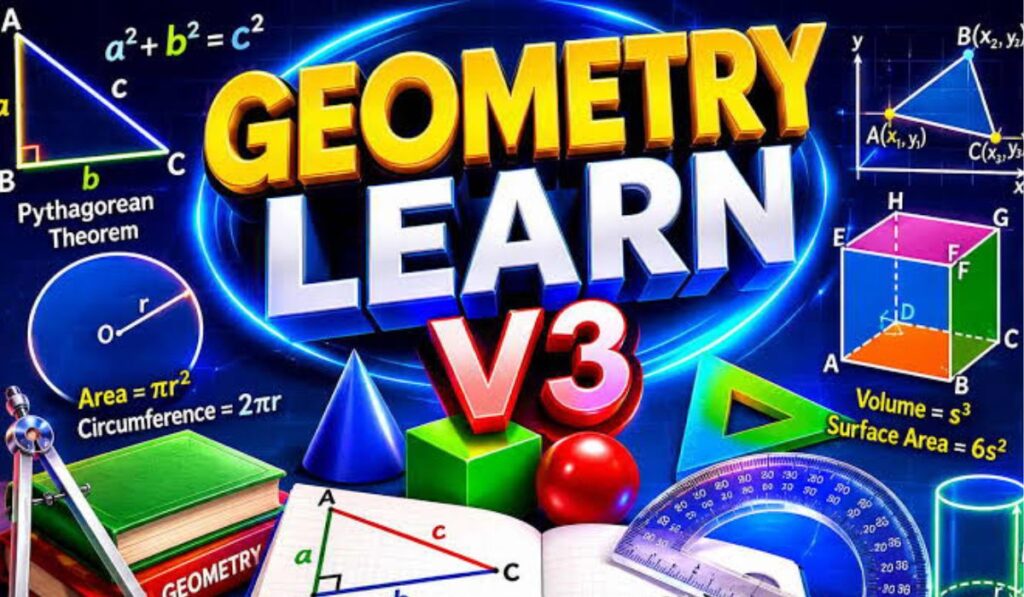
Geometry Learn V3 is a structured geometry course designed to simplify tough concepts using visuals, examples, and daily practice. It works as a complete geometry learning guide for students who want clarity instead of confusion.
Unlike traditional textbooks, this geometry tutorial focuses on real understanding. It combines geometry fundamentals with interactive practice, making it ideal for classrooms, homeschoolers, and anyone chasing stronger practical geometry skills in 2026.
What Geometry Learn V3 actually means
At its core, Geometry Learn V3 is a simplified system for learning shapes, angles, and spatial reasoning. It turns abstract math into relatable visuals, helping learners build geometry basics naturally through everyday comparisons and guided practice.
Who should use Geometry Learn V3?
This geometry learning platform suits school students, adult learners, teachers, and hobbyists preparing for tests. Anyone wanting a reliable geometry reference guide or a fresh approach to learn geometry step by step will benefit from its structure.
Why learners are choosing Geometry Learn V3 in 2026
People choose it because it saves time. Instead of memorizing rules blindly, students grasp geometry problem solving through visuals and repetition, making geometry revision faster, less stressful, and genuinely more enjoyable than old-style textbook learning.
How Geometry Learn V3 Makes Learning Geometry Easier
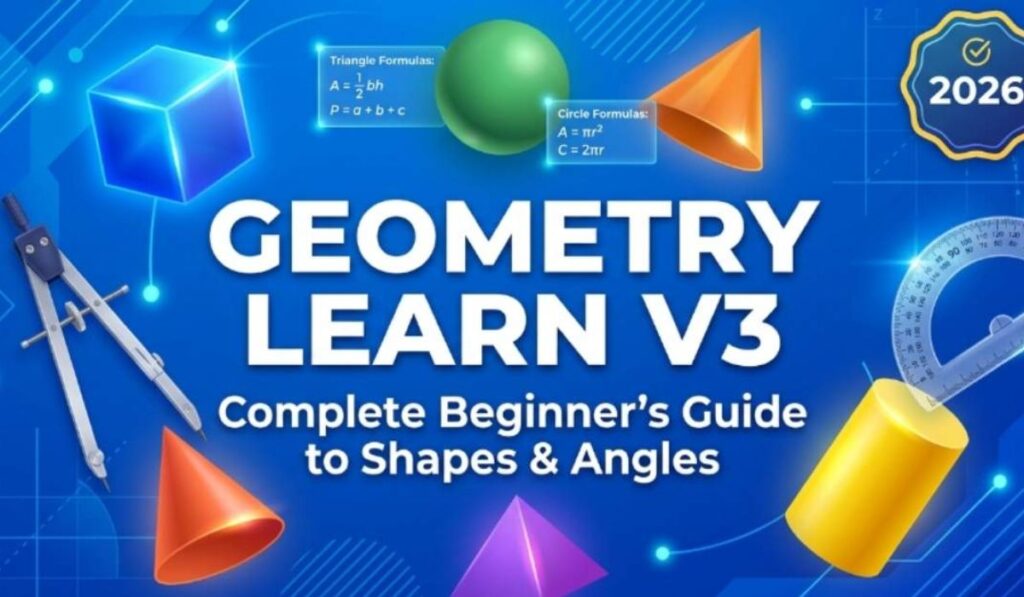
This platform simplifies math through beginner-friendly explanations, structured pacing, and constant visual support. Instead of dense theory, learners get short lessons that build confidence gradually using proven geometry learning methods designed for real retention.
Every lesson pairs practice with diagrams, reinforcing concept retention naturally. This approach turns confusing formulas into memorable patterns, helping learners tackle geometry exercises confidently while steadily strengthening their overall spatial reasoning and analytical thinking skills.
Beginner-friendly explanations
Complex ideas are explained using simple words and relatable comparisons. This beginner-friendly approach removes intimidation, letting new learners build geometry basics confidently before moving toward harder topics like angles, shapes, and coordinate systems.
Step-by-step learning approach
Lessons follow a logical order, so learners never feel lost. This step-by-step learning structure builds each new topic on previous knowledge, strengthening geometry fundamentals while keeping the pace comfortable and genuinely encouraging for beginners.
Visual learning and diagrams
Diagrams turn abstract math into something you can actually see. This visual geometry learning method helps learners connect shapes, angles, and formulas to real images, boosting spatial reasoning and long-term understanding significantly.
Better concept retention through practice
Repeated practice cements ideas in memory far better than passive reading. Through consistent geometry exercises, learners strengthen concept retention, making formulas and rules feel automatic rather than something constantly re-memorized before every test.
Geometry Basics Every Beginner Should Learn First
Every learner needs a solid foundation before tackling shapes or angles. Understanding point, line, and plane concepts builds the base for everything else in geometry basics, making advanced topics far easier to absorb later.
These foundational ideas describe 2D space and set the stage for vertex, edges, and face discussions later. Mastering them early prevents confusion when tackling triangles, circles, or coordinate geometry down the road.
- Point – a fixed position with no size
- Line – endless straight path in both directions
- Line segment – a line with two fixed ends
- Ray – starts at one point, extends forever
Points
A point marks an exact location in space with no length, width, or size. It’s the simplest building block in geometry, used to define vertices, mark positions, and anchor every shape and line drawn afterward.
Lines, line segments, and rays
A line extends infinitely both ways, a line segment has two endpoints, and a ray starts at one point and continues forever. These three basics form the backbone of nearly every geometric shape studied later.
Planes and flat surfaces
A plane is a flat, two-dimensional surface extending infinitely in every direction. Think of a flat surface like a tabletop or sheet of paper planes help visualize shapes, angles, and coordinate systems in 2D space.
Why these concepts are the foundation of geometry
Points, lines, and planes underpin every shape, angle, and formula in geometry. Without grasping these fundamentals, learners struggle later with polygons or coordinate geometry, making early mastery essential for smooth, confident progress ahead.
Understanding Angles Step by Step
An angle forms when two rays meet at a shared point called a vertex. This section introduces angle measurement, types, and real examples, giving learners the confidence to identify and calculate angles correctly and quickly.
Mastering angles is essential since they appear constantly in shapes, architecture, and daily life. Using a protractor and practicing consistently builds strong angle measurement skills that carry into more advanced geometry topics later.
What is an angle?
An angle is the space between two rays sharing a common endpoint, called the vertex. It’s measured in degrees and forms the foundation for understanding shapes, triangles, and countless real-world structural designs.
Types of angles
Common types include acute angle, right angle, obtuse angle, straight angle, and reflex angle. Each differs based on degree measurement, and recognizing them quickly helps solve shape and angle-relationship problems with ease.
- Acute – less than 90 degrees
- Right – exactly 90 degrees
- Obtuse – between 90 and 180 degrees
- Straight – exactly 180 degrees
- Reflex – more than 180 degrees
Measuring angles correctly
A protractor is the standard tool for angle measurement. Align the baseline with one ray, then read where the second ray crosses the scale. Practicing this regularly improves accuracy and builds real confidence.
Real-life examples of angles
Angles surround us daily, think of a clock, a pizza slice, a beam of light, or skateboard ramps. Spotting these examples helps learners connect abstract math to familiar, everyday visual experiences naturally.
Angle Relationships You Should Know
Beyond basic types, angles interact in predictable ways. Understanding angle relationships like complementary, supplementary, adjacent, and vertical pairs helps learners solve equations faster while strengthening overall logical thinking and problem-solving confidence.
These relationships also appear when a transversal crosses parallel lines, creating patterns like corresponding and alternate angles. Recognizing these patterns quickly is essential for exams, geometry proofs, and real design applications.
Complementary angles
Complementary angles add up to exactly 90 degrees. They often appear together in right-angle constructions, such as building corners or table edges, making them easy to identify once you know the pattern.
Supplementary angles
Supplementary angles total exactly 180 degrees, forming a straight line together. You’ll often spot these along a horizon or road markings, where two adjacent angles combine into one continuous straight path.
Adjacent angles
Adjacent angles share a common vertex and one side but don’t overlap. They sit right next to each other, commonly seen where railway tracks intersect or where two walls meet at a shared corner.
Vertical angles
Vertical angles form when two lines cross, creating two pairs of equal opposite angles. These matching pairs appear naturally in road markings, scissors, and any crossing-line design found in daily surroundings.
Angles formed by parallel lines
When a transversal cuts through parallel lines, it creates corresponding angles, alternate angles, and interior angles. These patterns are common in railway tracks and structural engineering layouts worldwide.
Understanding Shapes and Polygons
A polygon is any closed figure made of straight sides. This section explores regular versus irregular shapes and common polygon properties, helping learners quickly identify and classify shapes seen in daily life.
Recognizing polygons builds a base for triangles, quadrilaterals, and beyond. Strong shape identification skills make later topics like area and perimeter calculations far smoother and less intimidating for every beginner learner.
What is a polygon?
A polygon is a closed figure formed entirely of straight sides connected end to end. Common examples include triangles, squares, and hexagons—each defined by its number of sides and vertices.
Regular vs. irregular polygons
A regular polygon has equal sides and equal angles, like a perfect hexagon. An irregular polygon has mismatched sides or angles, such as an oddly shaped floor plan or uneven puzzle piece.
Common polygons and their properties
Different polygons carry unique polygon properties, from side count to angle sums, useful for identification and calculation.
| Polygon | Sides | Angle Sum |
| Triangle | 3 | 180° |
| Quadrilateral | 4 | 360° |
| Pentagon | 5 | 540° |
| Hexagon | 6 | 720° |
| Octagon | 8 | 1080° |
Triangles Explained Simply
Triangles are among the most useful shapes in geometry, appearing in bridge supports, roof trusses, and even the Eiffel Tower. This section explains triangle types by sides, angles, and their famous 180-degree rule.
Understanding triangles also builds groundwork for trigonometry later on. Recognizing an equilateral triangle, isosceles triangle, or scalene triangle quickly strengthens both classroom performance and everyday spatial reasoning skills.
Types of triangles by sides
Triangles classified by sides include the equilateral triangle (all equal), isosceles triangle (two equal), and scalene triangle (none equal). Each type has distinct properties useful for solving geometry problems accurately.
Types of triangles by angles
By angles, triangles fall into acute triangle, right triangle, and obtuse triangle categories. Knowing these helps quickly determine missing angles and supports accurate shape identification during tests or real design work.
The 180-degree triangle rule
Every triangle’s interior angles always sum to exactly 180 degrees. This simple triangle rule lets learners calculate any missing angle instantly, making it one of geometry’s most useful shortcuts.
Everyday examples of triangles
Triangles strengthen structures everywhere from bridge supports and roof trusses to the iconic Eiffel Tower. Their rigid shape makes them essential in architecture, engineering, and countless load-bearing construction designs worldwide.
Quadrilaterals Made Easy
A quadrilateral has four sides, and this family includes squares, rectangles, parallelograms, rhombuses, and trapezoids. This section simplifies each shape’s properties, helping learners quickly tell them apart using opposite sides and angle rules.
Comparing these shapes side by side builds strong shape identification skills. Recognizing parallel sides and equal angles becomes second nature with consistent practice and clear visual comparison across all quadrilateral types.
Squares and rectangles
A square has four equal sides and right angles, while a rectangle has equal opposite sides with right angles throughout. Both are common in interior design, flooring, and everyday building design layouts.
Parallelograms
A parallelogram has two pairs of parallel sides with equal opposite angles. This shape appears often in architecture and furniture placement, especially in slanted roofing or angled wall panel designs.
Rhombuses
A rhombus has four equal sides but angles that aren’t necessarily right angles, like a tilted square. It’s common in tile patterns, kite designs, and certain decorative architecture elements worldwide.
Trapezoids
A trapezoid has exactly one pair of parallel sides, unlike other quadrilaterals. This shape frequently appears in bridge supports, handbag designs, and certain structural layout elements in modern construction.
Comparing common quadrilaterals
Comparing these shapes side-by-side clarifies their unique polygon properties instantly.
| Shape | Sides Equal | Parallel Sides |
| Square | All 4 | 2 pairs |
| Rectangle | Opposite pairs | 2 pairs |
| Rhombus | All 4 | 2 pairs |
| Trapezoid | Not required | 1 pair |
Circles and Their Important Parts
A circle is a perfectly round shape with every point equidistant from its center. This section covers radius, diameter, chord, and circumference, giving learners the vocabulary needed for accurate circle-based calculations.
Circles appear constantly in daily life, from wheels to coins to clock faces. Understanding their parts and formulas strengthens both classroom accuracy and real-world practical geometry skills used in design and engineering.
Radius, diameter, chord, and circumference
The radius spans center to edge, the diameter crosses the entire circle, a chord connects two edge points, and the circumference measures the full outer boundary distance around the shape.
Essential circle formulas
Circle formulas rely heavily on π (pi) for accurate results.
| Measurement | Formula |
| Circumference | 2πr |
| Area | πr² |
| Diameter | 2r |
Real-world examples of circles
Circles show up everywhere wheels, coins, clock faces, and even a pizza slice sector. Recognizing these familiar shapes helps learners connect circle formulas to genuinely practical, everyday situations.
Perimeter, Area, Volume, and Measurement
Measurement topics like perimeter, area, and volume form the practical side of geometry. This section explains formulas, common units of measurement, and frequent calculation mistakes students should watch for during practice.
Getting comfortable with these formulas supports exam preparation and real-life tasks like space planning or furniture placement. Practicing regularly prevents confusion between square units and cubic units later on.
Understanding perimeter
The perimeter measures the total distance around a shape’s outer boundary. It’s calculated by adding all side lengths together, useful for tasks like fencing a backyard or framing a sheet of paper.
Calculating area
Area measures the space inside a shape, expressed in square units. Formulas vary by shape, but understanding the logic behind each one matters more than memorizing numbers blindly for exams.
Introduction to volume
Volume measures three-dimensional space inside solid objects, expressed in cubic units. It’s essential for tasks like filling a water tank or estimating material needed for construction projects.
Units of measurement
Common units of measurement include meters, centimeters, and inches for length, with squared or cubed versions for area and volume. Consistency across units prevents major calculation mistakes during problem-solving.
Common calculation mistakes
Frequent calculation mistakes include mixing units, confusing area with perimeter, or forgetting to square measurements. Slowing down and double-checking formulas prevents most avoidable errors during tests.
Symmetry, Congruence, Similarity, and Transformations
Symmetry, congruent figures, and similar figures describe how shapes relate through size, proportion, and mirrored balance. This section also covers basic geometric transformations used constantly in design and animation work.
These concepts strengthen visual thinking and appear in nature through butterfly wings and snowflake patterns. Mastering them helps learners recognize patterns quickly across art, architecture, and digital design fields.
Line symmetry
Line symmetry occurs when a shape mirrors perfectly across a central line, like a butterfly wings pattern or a snowflake. Folding the shape in half would create two identical, matching halves.
Rotational symmetry
Rotational symmetry means a shape looks identical after being rotated partway around its center. Objects like puzzle pieces, honeycomb cells, and certain flowers show this pattern naturally and repeatedly.
Congruent figures
Congruent figures are identical in size and shape, even if rotated or flipped. Two same-sized coins or matching tiles are classic real-world examples of perfect congruent figures.
Similar figures
Similar figures share the same shape but differ in size, maintaining equal proportion throughout. Scaled maps, model buildings, and resized photos are everyday examples of this useful geometric concept.
Basic geometric transformations
Core geometric transformations include translation (sliding), rotation (turning), reflection (flipping like a mirror image), and enlargement (resizing)—each reshaping figures while preserving their core properties.
Coordinate Geometry Basics
Coordinate geometry uses the Cartesian plane to locate and measure shapes using numbers. This section introduces the x-axis, y-axis, plotting techniques, and distance calculations essential for mapping and design work.
These skills connect directly to real tools like GPS navigation and architectural blueprints. Understanding the coordinate plane builds a bridge between visual geometry and precise, number-based mathematical reasoning.
Understanding the coordinate plane
The coordinate plane is formed by a horizontal x-axis and vertical y-axis crossing at zero. This grid system lets learners pinpoint exact positions using paired coordinate points for accuracy.
Plotting points
Plotting points involves marking exact locations using x and y values on the Cartesian plane. Practicing this regularly builds confidence for graphing shapes, lines, and more advanced coordinate-based problems.
Measuring distance between points
The distance formula calculates the exact space between two coordinate points on a graph. This calculation is essential for mapping routes, design work, and various real-world navigation tasks.
Real-world applications
Coordinate geometry powers GPS navigation, architectural blueprints, video game character movement, and mapping routes. These practical uses show why this topic matters far beyond the classroom.
Real-World Uses of Geometry Learn V3
Geometry shapes nearly every industry today, from architecture and construction to interior design, gaming, and animation. Structural layouts rely on triangles and quadrilaterals for stability, while 3D modeling and character movement in games depend entirely on coordinate systems and transformations.
- Architecture – planning building design and structural layout
- Construction – calculating load distribution and materials
- Gaming and animation – powering 3D modeling and movement
- Navigation – supporting maps and GPS coordinates
- Nature – explaining growth patterns found in nature
Even everyday life tasks like arranging a living room or planning a backyard rely on geometric thinking, proving these skills extend well beyond textbooks into genuinely practical daily situations everywhere.
Benefits of Learning Geometry Learn V3
Learning geometry strengthens far more than test scores. It builds problem-solving skills, sharpens logical thinking, and supports long-term academic success across multiple subjects, including physics and advanced mathematics courses later on.
Beyond school, geometry improves everyday decision-making, from estimating space to reading maps. These transferable skills make Geometry Learn V3 valuable for learners at every stage of their educational journey.
Builds problem-solving skills
Regular practice strengthens problem-solving skills by training the brain to break complex shapes into manageable steps, a habit that transfers well beyond math into everyday logical thinking challenges.
Improves logical thinking
Geometry demands structured reasoning, naturally improving logical thinking over time. This mental discipline helps with proofs, calculations, and even unrelated decision-making scenarios outside the classroom entirely.
Supports school and exam success
Strong geometry skills directly support exam preparation and standardized tests, since spatial reasoning questions appear frequently across school assessments, entrance exams, and general mathematical reasoning evaluations.
Makes advanced math easier
A solid geometry foundation makes calculus, physics, and advanced mathematical shape analysis far less intimidating later, since many advanced formulas build directly upon basic geometric principles learned early.
Helps in everyday decision-making
From space planning to furniture placement, geometry improves practical daily choices. This practical geometry skills foundation helps people estimate distances, sizes, and layouts confidently without needing formal tools.
Read It: Magfusehub com Overview: Features, Uses, and Practical Guide
How to Learn Geometry Faster
Speeding up geometry mastery requires consistent habits rather than shortcuts. This section shares proven geometry study tips, including diagramming, daily practice, and reviewing mistakes to build lasting, genuine understanding quickly.
Combining these habits with real-life geometry problems accelerates progress dramatically. Small, consistent efforts compound over time, turning confusing topics into confident, well-understood skills within just a few focused weeks.
Draw diagrams while studying
Sketching diagrams while studying reinforces visual thinking and helps cement abstract formulas into memorable images, making recall during tests significantly easier and far less stressful overall.
Practice every day
Consistent daily practice strengthens memory far better than occasional cramming. Even short daily geometry exercises build steady concept retention and long-term mastery over several weeks.
Understand formulas instead of memorizing
Focusing on formula understanding rather than blind memorization helps learners apply concepts flexibly. This approach supports genuine understanding of geometry rather than fragile, easily forgotten knowledge.
Solve real-life geometry problems
Practicing real-life geometry problems, like measuring rooms or estimating distances, connects abstract lessons to daily life, strengthening both motivation and genuine practical geometry skills simultaneously.
Review mistakes regularly
Regularly reviewing errors through review mistakes sessions highlights recurring weak points. This habit prevents repeated errors and steadily builds sharper, more reliable geometry problem solving skills over time.
Common Geometry Mistakes to Avoid
Many learners repeat the same avoidable errors throughout their studies. This section highlights frequent calculation mistakes, from confusing formulas to skipping diagrams, helping learners avoid common pitfalls during practice and exams.
Awareness is often the fastest fix. Recognizing these patterns early prevents frustration and supports smoother, more confident progress through every geometry topic covered throughout this geometry learning guide.
Confusing area with perimeter
A frequent mistake involves confusing area with perimeter, mixing up boundary distance with enclosed space. Remembering that area uses square units while perimeter doesn’t help avoid this common error.
Memorizing without understanding
Memorizing without understanding formulas leads to fragile knowledge that collapses under pressure. Prioritizing formulas understanding instead builds flexible, lasting skills that hold up during unfamiliar exam questions.
Ignoring diagrams
Skipping diagrams while solving problems often causes avoidable errors. Sketching even rough shapes clarifies relationships between angles and sides, making shape identification and calculations noticeably more accurate.
Misidentifying shapes
Misidentifying shapes happens when learners rush without checking side lengths or angles carefully. Slowing down to verify properties prevents this frequent, easily avoidable shape identification mistake.
Skipping practice
Skipping practice weakens concept retention over time, making formulas harder to recall later. Consistent, even brief, daily practice sessions keep skills sharp and genuinely exam-ready.
Quick Geometry Reference Sheet
| Topic | Key Formula / Fact |
| Triangle angle sum | 180° |
| Quadrilateral angle sum | 360° |
| Circle circumference | 2πr |
| Circle area | πr² |
| Complementary angles | Sum to 90° |
| Supplementary angles | Sum to 180° |
| Rectangle area | length × width |
| Square perimeter | 4 × side |
This quick geometry reference guide is perfect for last-minute geometry revision before tests, summarizing the most essential formulas and facts covered throughout this entire geometry study guide in one convenient place.
Frequently Asked Questions
How can I start learning shapes easily?
Geometry Learn V3 makes learning shapes, lines, and angles simple with easy lessons.It helps beginners understand geometry step by step.
What is the easiest way to understand angles?
Practice every day with Geometry Learn V3 using clear examples and simple exercises.It makes angle concepts easier to remember.
Which app helps me practice geometry daily?
Choose Geometry Learn V3 for daily practice and beginner-friendly geometry lessons.It helps improve your skills with simple activities.
How do I improve my geometry test scores?
Study regularly with Geometry Learn V3 and solve easy practice questions.It builds confidence before quizzes and exams.
Can beginners learn geometry without a teacher?
Yes, Geometry Learn V3 offers simple explanations for self-learning.It helps you understand geometry at your own pace.
Where can I learn geometry with simple examples?
Use Geometry Learn V3 to learn through clear examples and easy explanations.It makes difficult geometry topics easier to understand.
What is the best way to remember geometry formulas?
Review formulas often with Geometry Learn V3 and practice regularly.It helps you remember important geometry formulas with confidence.
Conclusion
Mastering geometry doesn’t require memorizing endless rules; it requires understanding patterns, practicing consistently, and connecting shapes to real life. Geometry Learn V3 simplifies this entire journey through visuals, structure, and steady, encouraging progress for every learner.
Whether you’re a student, parent, or curious adult, this geometry learning guide proves geometry can be approachable and even enjoyable. With consistent practice and the right support, understanding geometry becomes a genuinely achievable, rewarding goal for everyone in 2026.